


| File Name: | Vehicle Suspension Design In Siemens NX 2506 |
| Content Source: | https://www.udemy.com/course/vehicle-suspension-design-in-siemens-nx-2506/ |
| Genre / Category: | Other Tutorials |
| File Size : | 4.3 GB |
| Publisher: | TechDesign Academy |
| Updated and Published: | January 5, 2026 |
1. Core Design Principles:
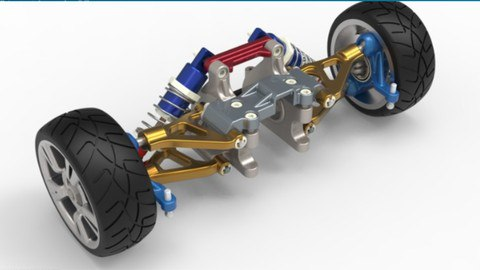
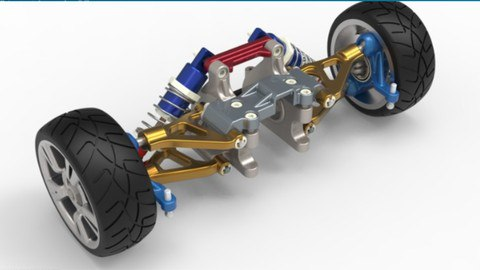
- Suspension System Fundamentals: Understanding different types of suspension (e.g., MacPherson Strut, Double Wishbone, Multi-link) and their kinematic properties.
- Design in NX CAD: Using NX tools, particularly the enhanced features in the NX 2506 release for sketcher, curve creation, and advanced shape design, to model individual suspension components.
- Assembly Modeling: Creating a full suspension assembly within NX, correctly applying assembly constraints to define component relationships and movement according to design intent.
Why Do We Need a Suspension System?
- Safety and Control (Maximizing Road Contact): The most important function is to maximize the friction between the tires and the road surface, a principle known as road holding. Roads are rarely perfectly smooth; hitting a bump causes the wheel to move rapidly. Without suspension, the wheel could lose contact with the road, making it impossible to steer, brake, or accelerate safely. The suspension manages this vertical wheel movement to ensure the tire remains planted on the ground at all times.
- Ride Comfort: It absorbs and dampens the shocks, vibrations, and impacts caused by road imperfections (potholes, bumps, uneven terrain). This prevents the energy from being directly transferred to the vehicle’s frame and occupants, providing a smooth and comfortable ride.
- Stability and Handling: It controls the vehicle’s motion during driving maneuvers:
- Body Roll: Limiting how much the body leans when cornering.
- Pitch: Limiting the nose-dive during braking and the rear-squat during acceleration.
- Supporting Weight: The springs support the entire weight of the vehicle and its cargo.
How Does a Suspension System Work?
The system operates through a coordinated effort between three main types of components: Springs, Dampers, and Linkages.
1. Springs (Energy Storage)
- Function: To support the weight of the vehicle (the sprung mass) and absorb the initial impact of a bump by compressing and storing the energy.
- Types: Common types include coil springs (the most common in passenger cars), leaf springs (common in trucks/heavy-duty vehicles), and torsion bars.
2. Shock Absorbers (Dampers) (Energy Dissipation)
- Function: To control the uncontrolled oscillation (bouncing) of the springs. When a spring is compressed, it tries to expand back and will continue to bounce until all its stored energy is dissipated.
- Mechanism: A shock absorber is essentially an oil-filled cylinder with a piston and small holes (orifices). As the spring oscillates, the piston moves, forcing hydraulic fluid through these small holes. The resistance created by this flow converts the kinetic energy of the spring’s movement into heat, which is then safely dissipated, quickly stabilizing the vehicle.
3. Linkages and Controls
- Control Arms (or Wishbones): These are movable levers that connect the wheel assembly (steering knuckle) to the vehicle’s frame, allowing the wheel to move vertically while controlling its fore-aft and lateral position.
- Ball Joints: Pivoting points that allow the control arms and steering knuckle to move in various directions.
- Sway Bar (Anti-Roll Bar): A torsion spring linking the left and right suspension on the same axle. Its main job is to resist body roll during cornering by transferring force from the wheel on the outside of the turn (which is being compressed) to the inside wheel, keeping the car flatter.
DOWNLOAD LINK: Vehicle Suspension Design In Siemens NX 2506
Vehicle_Suspension_Design_In_Siemens_NX_2506.part1.rar – 1000.0 MB
Vehicle_Suspension_Design_In_Siemens_NX_2506.part2.rar – 1000.0 MB
Vehicle_Suspension_Design_In_Siemens_NX_2506.part3.rar – 1000.0 MB
Vehicle_Suspension_Design_In_Siemens_NX_2506.part4.rar – 1000.0 MB
Vehicle_Suspension_Design_In_Siemens_NX_2506.part5.rar – 303.7 MB
Note:- Connect VPN before opening Download Links!